
Managing Bioinformatics Workflows in Veterinary Diagnostics Using Globus
Michigan State University Veterinary Diagnostic Laboratory

Veterinary diagnostic laboratories across the US perform critical functions to safeguard both the human and pet food supply. Because of the vital nature of this work, the diagnostic testing they perform must adhere strictly to federal regulations and accreditation standards. Historically, conventional testing methods like PCR have been the standard; while PCR tests are inexpensive, fast, scalable, and require minimal technical expertise, they yield highly limited data.
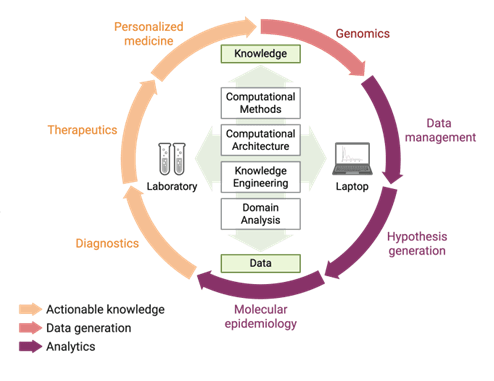
To bridge this gap, an emerging approach which combines genomic sequencing and bioinformatics is transforming the field. Genomic sequencing and bioinformatics allow researchers to analyze entire genetic sequences, offering a wealth of information crucial for novel pathogen discovery, oncology, and precision medicine.
However, because bioinformatics blends biology and computer science to extract actionable insights, interpreting these massive datasets requires highly specialized expertise and complex workflows. The combination of a steep learning curve and a lack of affordable commercially available, graphical user interface (GUI) based applications often creates a massive barrier to adoption. Globus helps researchers overcome these obstacles by providing an intuitive user interface backed by powerful data management and automation capabilities.
A Bacterial Whole Genome Assembly Pipeline With Globus
Globus streamlines the entire process from the laboratory bench to final data analysis. Using a pre-built automation “flow” and a user-friendly web interface, even researchers with limited bioinformatics training can initiate a complex bacterial whole-genome assembly pipeline. The user simply navigates to the Globus web application, selects the appropriate Globus Flow, chooses the directory containing their raw data, and adds custom tags for easy tracking. Once the automated run is launched, the researcher can step away—Globus handles the data transfer and processing, sending an email notification the moment the job is complete.
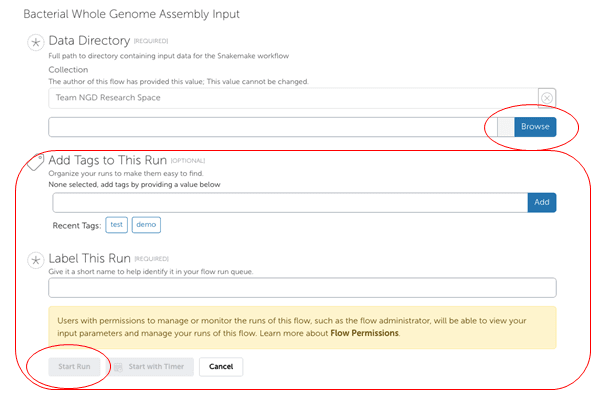
With this new approach, users can repurpose Flow components, update pipelines as needed, and even trigger flows to run when the acquisition instrument completes a sequencing run.
Quotes
-
Globus takes the analysis off my plate and allows me to focus on more development projects to keep driving innovation forward."
- Kayla Conner-Halim, Ph.D. Section Chief, Genomics and Bioinformatics, Michigan State University Veterinary Diagnostic Laboratory