
Globus Accelerates Drug Development at Superluminal Medicines
Superluminal Medicines

Superluminal Medicines, a Boston-based biotech, is revolutionizing the speed and accuracy of medicine development. Currently they are developing a pipeline of next-generation small-molecule GPCR-targeted treatments for endocrine and cardiometabolic diseases. They use Globus in their cross-facility instrument workflow to move data, automate repetitive tasks, and manage compute resources.
Superluminal Medicines works with multiple CryoEM instruments at universities around the world. Each instrument facility generates approximately 2-5 TB per day of use. All these data are transferred via Globus to Montana State University, where Superluminal utilizes an HPC cluster for processing data and building atomic models. Once transferred, they reconstruct electron density maps and model in atomic structures. The atomic modeling step requires constant local viewing and editing in UCSF ChimeraX, followed by compute-intensive refinement on the cluster.
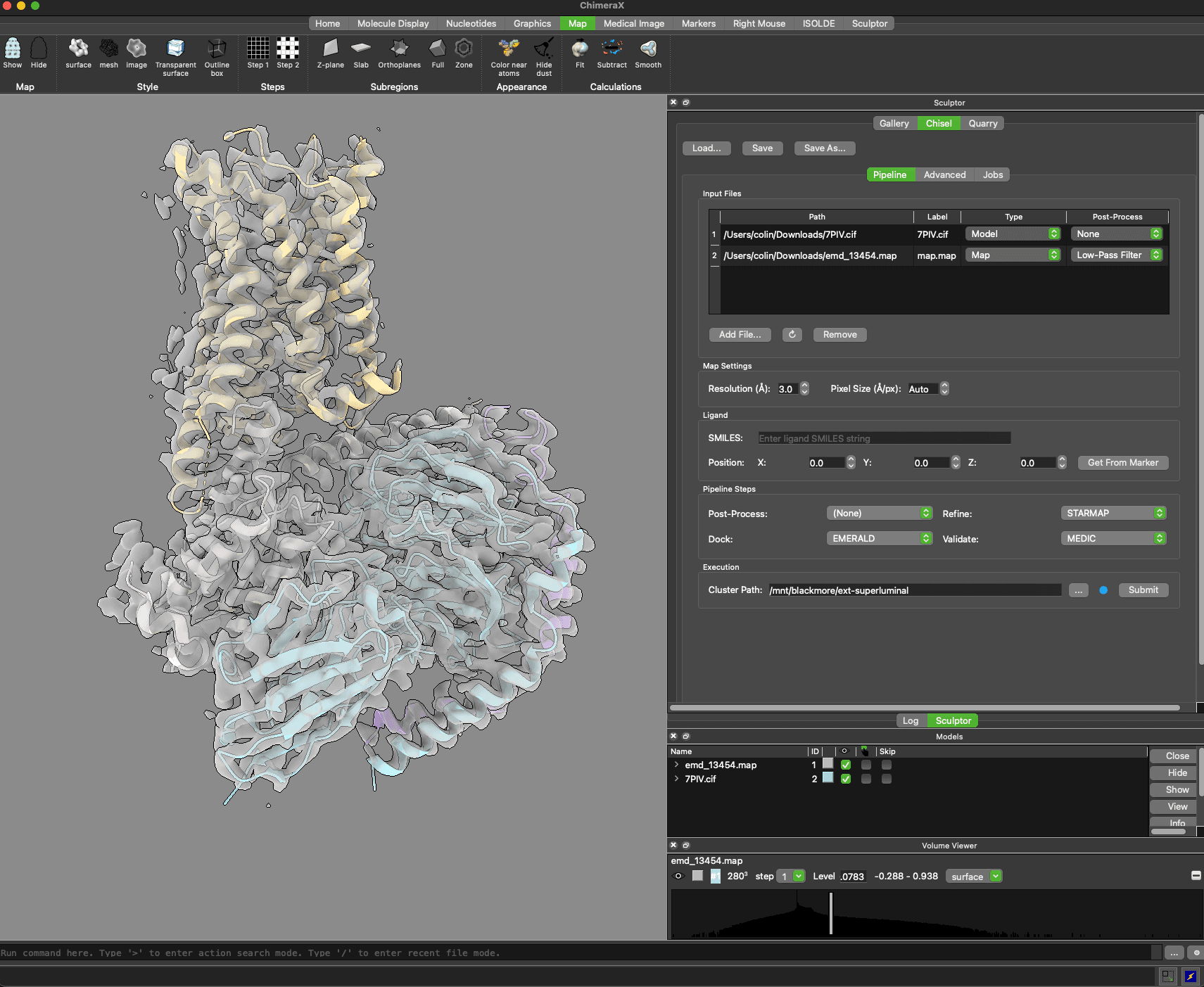
Prior to the implementation of Globus Compute many steps were required in the process. A user would need to edit the model in ChimeraX witih the ISOLDE plugin, save it, log in to a VPN, manually transfer files to the HPC, SSH into the HPC, setup and run the refinement software, and monitor the job and then transfer the files back to the local computer for analysis. Since this process was often iterated 3-5 times, the time cost and added friction was significant.
Now with Globus users simply “press a button” and together with Globus Flows, a data task automation service, the entire process is automated. And with Globus Compute, there is the added flexibility as to where the compute takes place. If the HPC cluster is down for maintenance, the research process does not stop. It is now easy to send the processing task to a different compute endpoint simply by changing the destination ID in the flow parameters.
Quotes
-
I used to dread having to refine models because of the constant logging in and out and transferring back and forth. Now we can quickly iterate, and with Globus all the friction in the process is eliminated."
- Colin Gauvin Sr. Scientist, Structural Biology, Superluminal Medicines