Globus provides the backbone service for the Human Organ Atlas Repository
March 31, 2026
Science Advances recently published an article on the Human Organ Atlas (HOA), a groundbreaking open-access online repository that enables anyone to explore the human body’s organs in unprecedented 3D detail down to the level of individual cells. Created by an international team led by researchers from University College London and the European Synchrotron Radiation Facility, the HOA uses the cutting-edge HiP-CT imaging technique, powered by the world’s brightest X-rays, to scan whole organs without damaging them.
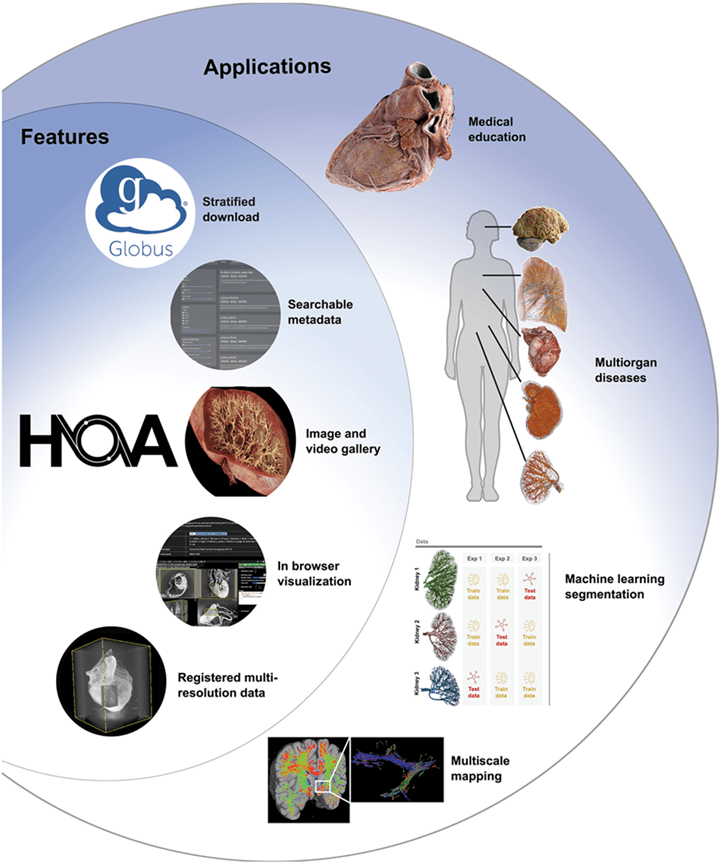
Fig. 1. Overview of the HOA. Features include open data download, search tools based on metadata, image/video galleries, browser-based visualization, and registered hierarchical datasets. (Reproduced under a Creative Commons Attribution 4.0 International License.)
The HOA provides the most detailed 3D anatomical atlas ever created, bridging the gap between radiology and histology. The platform supports collaborative science, open data, and innovation in biomedical imaging and analysis. With the HOA users can discover real—not idealized—human anatomical data, transforming how we understand health and disease. The HOA’s high-resolution datasets are essential for future breakthroughs in AI-driven medical research.
Globus services are used in the HOA data portal to provide reliable and efficient downloading of large imaging datasets. This enables researchers worldwide to access multiscale organ imaging files—many of which are hundreds of gigabytes or even terabytes in size—with speed and security, overcoming the challenges of typical web browser downloads. For users with limited computational resources, the HOA also offers downsampled and compressed versions for easier access.
We are excited to see this seminal work from the University College London and the European Synchrotron Radiation Facility, both of which are long-time Globus subscribers.