Homecoming: Globus and SC, Thirty Years On
November 11, 2026 | Ian Foster
For the first time since the conference began in 1988, SC comes to Chicago this month. For those of us who have spent our careers at Argonne National Laboratory and the University of Chicago, the dateline alone is pleasing. But the connection runs deeper than geography: Globus began at SC.
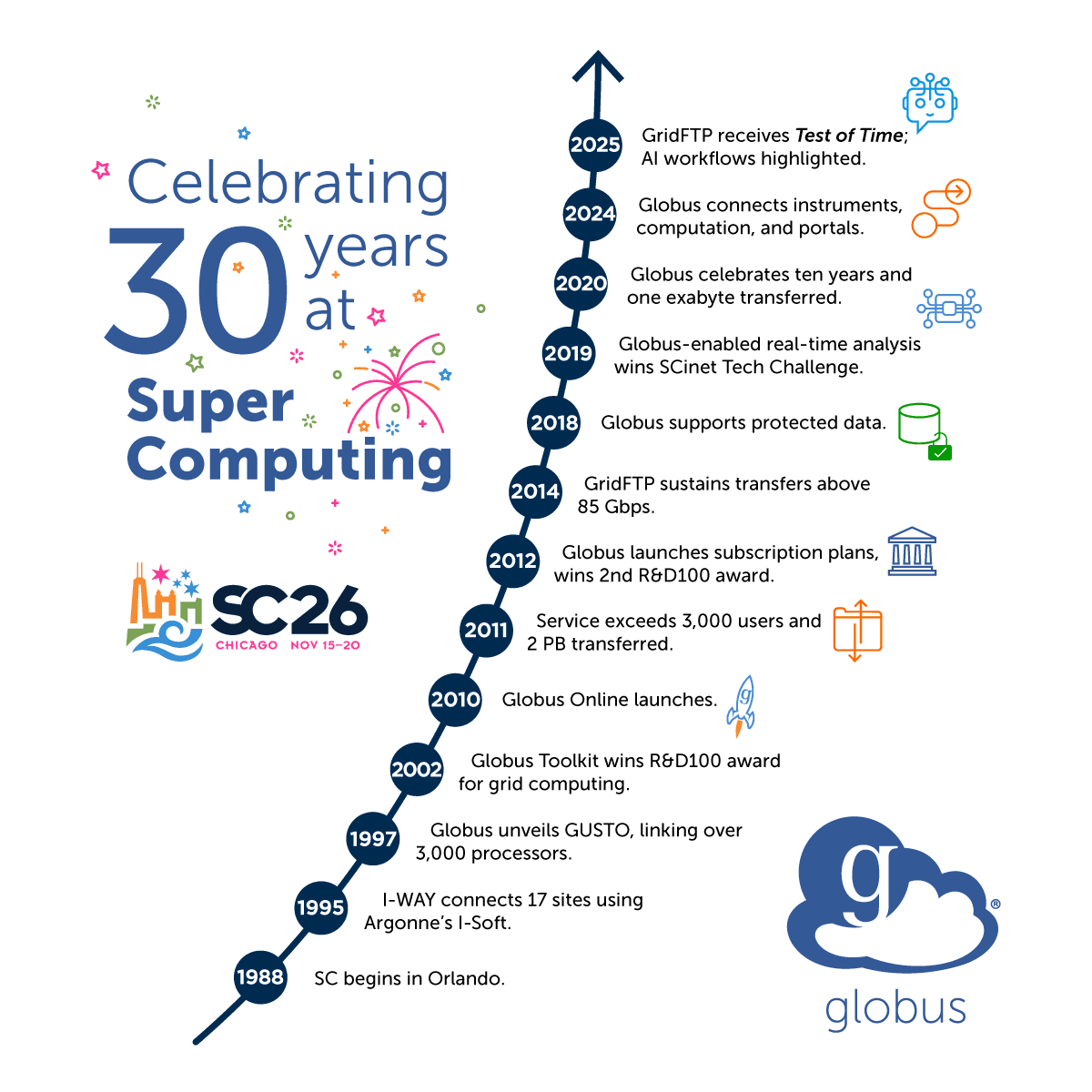
At Supercomputing 1995 in San Diego, the I-WAY experiment linked 17 sites across North America over a dozen ATM research networks, demonstrating that geographically distributed supercomputers, instruments, and visualization systems could work as one. Our group at Argonne built I-Soft, the software infrastructure that held the experiment together: authentication, scheduling, and a uniform environment across those 17 sites. The name Globus dates to a DARPA grant awarded that same year, and in 1996 the Globus Project was established as a collaboration between Argonne and USC’s Information Sciences Institute. The open-source Globus Toolkit that followed powered TeraGrid, the Open Science Grid, the Worldwide LHC Computing Grid, and the LIGO Data Grid.
Those deployments also taught us the limits of the approach. Middleware that every site must install, configure, and maintain demands local expertise that most institutions cannot spare. Grid computing worked well for the projects that could staff it, and poorly for everyone else.
So in 2010 we made a different bet: move the complicated parts—the services that manage identity, schedule transfers, and recover from failures—into professionally operated, cloud-hosted services, and leave at each institution only lightweight software that moves data and enforces local policy. Researchers get a web interface that requires no distributed-systems expertise; developers get REST APIs; institutions keep control of their storage and their rules. We launched the result as Globus Online at SC10 in New Orleans.
Fifteen years of operation make a fair test of that bet. In its first year the service moved 0.2 petabytes; it now move roughly two petabytes every day. Nearly 900,000 users and applications are registered, spanning more than 2,600 institutions in over 80 countries. The architecture we chose in 2010 has carried that growth largely unchanged, while the platform around it has grown to include protected data management, data sharing, search, automation, and remote computation.
The people who build and run Globus work for the University of Chicago in Hyde Park, a few miles down the lakefront from McCormick Place. I’m grateful to have worked alongside them, and for the care they bring to the work that researchers count on every day. If you are at SC this year, come by booth 2054 and meet them.
We can show you what two petabytes a day looks like from the operations side, and what we are building next for instruments, data stewardship agents, automation, and exascale data. After thirty years of taking Globus to SC, we are glad to have SC come to Globus.